“Words can be more stable than pictures”

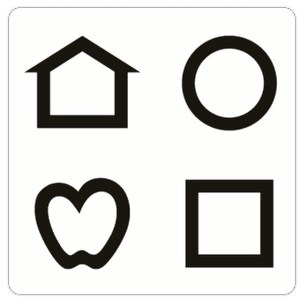
"Words can be more stable than pictures"  "For children with CVI, words can be more stable than pictures." This was another piece of CVI wisdom from Christine Roman-Lantzy that this CVI mom had heard repeatedly, it seemed, these last few months. But it was at our ophthalmology appointment that it played out right before my eyes.  To say that cortical visual impairment is a complex diagnosis is an understatement. Along with CVI, we have amblyopia, astigmatism, hemianopsia, myopia, nystagmus, strabismus, and most recently, anisometropia. While some of these can be considered ocular impairments, they are also intrinsically tied to CVI, or at least to the brain injury and damage that resulted in my son's cortical visual impairment. Anisometropia, by its simplest definition, is a difference in acuity between the two eyes. When it comes to my son's vision, even acuity is imperfect. The problem became apparent when Jasper started covering his left eye whenever he looked at...anything. The parent-teacher solution was to tell him to stop doing this - but our kids' behavior has meaning and purpose. So instead of covering that left eye, Jasper began shutting it whenever he looked at...anything. Because the left eye is weaker - the stroke that damaged his occipital lobes was greater on the right than the left - he had come to rely on the right eye, creating an imbalance in his acuity. Use it or lose it.  Ever since the diagnosis of anisometropia two years ago, we follow up with the ophthalmologist every four months. Well aware of the complexity of my son's vision, that acuity test hits hard every time. Lea Symbols are commonly used to test the distance acuity of children beginning at age 2 1/2. The four symbols are a circle, apple, square, house. For a child with CVI, it seems fair to review the symbol shapes prior to the test. Circle, square...is that another square? No, it is similar to square on the bottom but is pointy on top, with edges that point down, like the roof of a house, it must be a house. And is that another circle? It is circular but curves in at the top and bottom, similar to an apple, how it curves at the top where the stem is, that must be an apple. But this is not what happens and my son, who loves going to the ophthalmologist, struggles in the exam chair from 25 feet away to distinguish the salient features of the house and the apple. Each time, the same thing. He might get one or two correct.  Except last time. Jasper is now six years old, beginning first grade. The doctor's assistant asks, Does he know the alphabet? Yes - yes!! And instead of Lea symbols, letters appear on the screen across the dimly lit room. Holding my breath, Jasper reads off the letters. Still imperfect, but this time he is able to identify almost all of the letters. Instead of only one or two correct, he misses two or three. It is amazing and by far the best he has ever performed on a distance acuity test.  "For children with CVI, words can be more stable than pictures." Stunned, the words came to me almost immediately afterward, and I jot them down just as the doctor arrives to finish the exam. Comparing Jasper's struggle with abstract pictures versus plain old letters, forces a kind of acceptance. As the parent of a child who has CVI, you see that struggle every day. Reading those letters feels less like a struggle and more like an accomplishment and we will take that and run with it.
“Words can be more stable than pictures”

“For children with CVI, words can be more stable than pictures.” These were the words of Christine Roman-Lantzy that this CVI mom had heard repeatedly, it seemed, this past year. But it was at our ophthalmology appointment that the words played out right before my eyes. Continue reading ““Words can be more stable than pictures””
CVI back to school

CVI back to school
CVI back to school

Ours seems to be the last district that goes back to school in the fall. Not the day after Labor Day but the day after the day after Labor Day. And so the holiday weekend is spent gathering and updating documents and resources for teaching new school team members about cortical visual impairment (CVI). Since somebody asked, it seemed like a good idea to talk about what those materials look like. Continue reading “CVI back to school”

Phase III CVI Workshop: Salient features and the red pom pom

boston-bike.jpg
Phase III CVI Workshop, Boston

If not for CVI conferencees, trainings and assessments, this CVI mom would never go anywhere. My son has been in Phase III CVI (Roman-Lantzy) for more than a year. Now the goal is to learn as much as possible about Phase III, what that means, and how best to support him, especially as a student with CVI in the general education setting. Watching my son progress along the CVI Range has been everything from exhilirating to gruelling. Being in Phase III is sort of like slowing down as you near the end of the road. But knowing you will never quite reach the end. And so last spring I attended a two day workshop on Phase III CVI at Perkins School for the Blind, taught by Christine Roman-Lantzy. Continue reading “Phase III CVI Workshop: Salient features and the red pom pom”

What Jasper Sees

'What Jasper Sees'Amblyopia. Exotropia. Hemianopsia. Nystagmus. Strabismus. Homonymous bilateral field defects. Cortical visual impairment. All are words that describe Jasper’s vision disability. Add to that cognitive, communication,  developmental, feeding, fine motor delays, and seizures. Twelve words to describe Jasper’s vision. Simple, right? Continue reading “What Jasper Sees”

“Thank you for making me cry at an IEP meeting”

Stay goldThese were the words of my son’s kindergarten teacher on our last field trip of the year. Earlier that week we had yet another IEP meeting, to hash out his vision goals, at my insistence. Partway through the meeting, it seemed appropriate to stop and acknowledge the final stretch of the school year, and my son’s progress at the end of kindergarten. Continue reading ““Thank you for making me cry at an IEP meeting””