 Amblyopia. Exotropia. Hemianopsia. Nystagmus. Strabismus. Homonymous bilateral field defects. Cortical visual impairment. All are words that describe Jasper’s vision disability. Add to that cognitive, communication, developmental, feeding, fine motor delays, and seizures. Twelve words to describe Jasper’s vision. Simple, right? Continue reading “What Jasper Sees”
Tag: CVI
As Jasper learns to ride a bike, it is hard not to think back to those early days in 2011 when he was diagnosed with Cortical Visual Impairment. He was about a week old when his neurologist gave me the diagnosis, “Cortical Blindness” she called it. She recommended registering him with Services for the Blind and added that “color vision is usually intact.” She continued, because my son’s visual impairment involved the brain, and not the eye – there was nothing wrong with my son’s eyes – there was nothing that could be done to improve his vision. Continue reading “Learning to ride a bike”
Upcoming training on Phase III CVI, in Maryland, below is a link to registration page:
“Cortical Visual Impairment, A Focus on Phase III Learners”
Presenter: Dr. Christine Roman-Lantzy
June 19 – 23, 2017
This workshop is designed to provide assessment and educational information regarding Cortical Visual Impairment, specifically for children who score in Phase III on The CVI Range. Participants will gain knowledge and skill to better identify, assess, and educate children who have CVI. This is NOT an introductory CVI course!
The Institute is designed for participants who have experience and prior knowledge of CVI. This is not an introductory course!
The course content is specifically relevant for individuals who live or work with children who have cortical visual impairment with or without other disabilities. This Institute is designed to meet the needs of regular and special educators, family members, related service providers, administrators, teachers of the visually impaired, and teachers of the deaf/hard-of-hearing who work directly or indirectly with students with dual sensory impairments and/or cortical visual impairment, Phase III.
2017 Institute Schedule
Monday – Friday, June 19 – 23, 2017
8:30 – 9:00 am Registration and continental breakfast
9:00 am – 12:00 pm Institute Program
12:00 – 1:00pm Lunch (on your own)
1:00-4:30 pm Institute Program
CVI, A Focus on Phase III Learners link to info and registration page.

On our way home from afternoon preschool, we stop at the playground. This has become our habit on these warm spring days. We were not there long before Jasper made a friend, Robin, or rather, she befriended him. “Let’s go slide together, Jasper!” she said, taking his hand, pulling him along, not aware that she was leading him. Robin called to Jasper “Come swing with me!” and Jasper followed the pink blur of her shape, running behind her, both of them laughing. Continue reading “Friend”
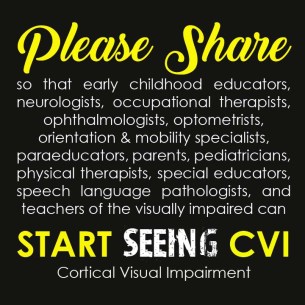 Start Seeing CVI recently featured a graphic as a thank you for the growing number of followers on Facebook. For parents who have a child with Cortical Visual Impairment (CVI), the message is immediate and personal. Since my son’s diagnosis with CVI shortly after his birth in 2011, we have worked with dozens of providers. In that time, of the numerous doctors, specialists, therapists we have seen, most had not heard of CVI. We live in a major metropolitan city – Seattle – and yet I have been asked by neurologists and pediatricians to explain my son’s vision diagnosis, and I have responded to questions such as “So what does he SEE??”
Awareness for parents also needs to grow. Early on, when my son was still an infant, I found the support of other special needs moms in a monthly group. Our commonality was that all of our kids had seizures. After joining the group and talking about my son and CVI, three of the five moms in the group recognized the characteristics of CVI in their own children. All of these kids were older than my son, had multiple disabilities, and no one within their medical, early intervention or therapy teams had ever mentioned Cortical Visual Impairment.
CVI is the leading cause of visual impairment in children in this country, according to the National Institutes of Health. Greater awareness of Cortical Visual Impairment needs to happen now. Increased awareness will bring an increase in diagnoses. In time this will bring an increase in funding and desperately needed research.
So please keep sharing – so that early childhood educators, neurologists, occupational therapists, ophthalmologists, optometrists, orientation & mobility specialists, paraeducators, parents, pediatricians, physical therapists, special educators, speech language pathologists, and teachers of the visually impaired can Start Seeing CVI.
Edmond, JC, and Foroozen, R. Cortical Visual Impairment in Children. https://www.ncbi.nlm.nih.gov/pubmed/17065917.
 Start Seeing CVI