Thinking about visual access in terms of the arts can feel overwhelming. How can a child who has cortical visual impairment (CVI) possibly have access to and enjoyment of, an arts experience? On a recent outing to our local children’s theatre, it hit home how visual access makes a world difference for a child who has CVI. Continue reading “Access makes a world of difference”→
Recently I had yet another conversation with a distraught parent from another state, who was upset that her child who has cortical visual impairment (CVI) was not being included in the story/circle time at preschool. “He doesn’t need to see the pictures,” the parent was told.Continue reading ““Fire is so loud””→
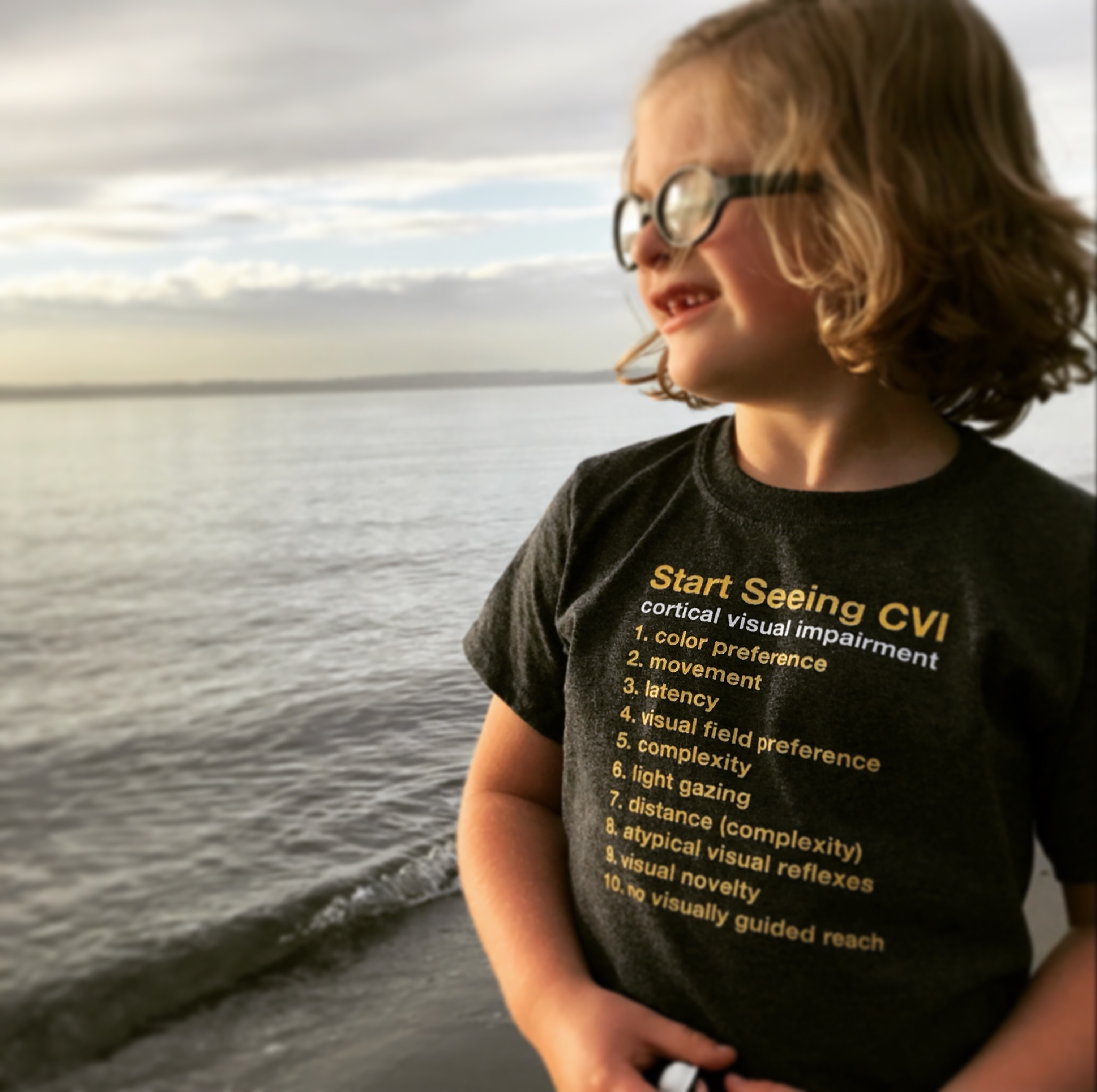
The original t-shirt design, pictured at right, and on our Facebook page, can be ordered in kids sizes here. This design and the terms used to describe the ten characteristics reflected the then current language used around CVI, and comes from Cortical Visual Impairment: An Approach to Assessment and Intervention by Christine Roman-Lantzy. The t-shirt idea, along with the name, Start Seeing CVI, was born out of a parent’s frustration from dealing with providers who had never heard of CVI, and the constant explanation of both my son, and his vision disability. This happened by the time he transitioned from birth to three services to the public school system. The t-shirt was made as he began preschool, with a new team that either did not know CVI at all, or did not know nearly enough. His new IEP team strongly recommended instruction in Braille, and this CVI mom declined. And I sent my son to school wearing his Start Seeing CVI t-shirt.
Start Seeing CVI. So that early childhood educators, occupational therapists, ophthalmologists, optometrists, orientation & mobility specialists, pediatricians, physical therapists, special educators, speech language pathologists, and teachers of the visually impaired can Start Seeing Cortical Visual Impairment.
What to include in an IEP for a student who has CVI
Whether you are a parent of a child with cortical visual impairment (CVI), a teacher of the visually impaired (TVI), therapist or other provider, most people struggle when it comes to writing IEPs (Individualized Education Program) for students who have CVI. With input from TVI Matt Tietjen*, here is what to include for students with CVI. The IEP format looks different from state to state, but they all contain the same information. It should be noted that our source for all discussion of cortical visual impairment, the Phases, ten characteristics, accommodations and modifications is Cortical Visual Impairment: An Approach to Assessment and Intervention, by Christine Roman-Lantzy. Continue reading “What to include in an IEP for a student who has CVI”→

 Start Seeing CVI