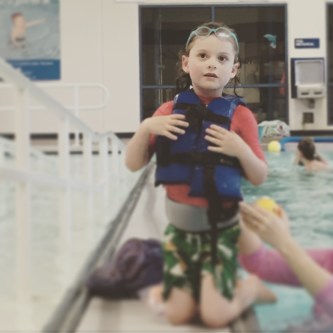
 The face your child makes when he cannot recognize you. I am there, maybe twenty feet in front of him, calling his name. The balmy therapy pool is not busy but the indoor acoustics of water and splashing and concrete interfere with the sensory processing necessary for locating mommy by voice. Cortical visual impairment interferes with sorting out and distinguishing the visual information of mommy, and the background grid of cubbies stuffed with tote bags, shoes and brightly colored towels. Standing almost directly in front of him, my son moves his head to the left, shifting me into his right, or preferred visual field, unsure of whether he hears his mother’s voice, and unsure where to find me in that space. Continue reading “‘So hard, this CVI’”
Category: CVI

“For children with CVI, words can be more stable than pictures.” These were the words of Christine Roman-Lantzy that this CVI mom had heard repeatedly, it seemed, this past year. But it was at our ophthalmology appointment that the words played out right before my eyes. Continue reading ““Words can be more stable than pictures””
Ours seems to be the last district that goes back to school in the fall. Not the day after Labor Day but the day after the day after Labor Day. And so the holiday weekend is spent gathering and updating documents and resources for teaching new school team members about cortical visual impairment (CVI). Since somebody asked, it seemed like a good idea to talk about what those materials look like. Continue reading “CVI back to school”
 For parents of children with special needs, including and especially CVI parents, summer affords a much needed respite from contending with schools and IEP teams. While we do not need to focus on those essential classroom adaptations and accommodations that are necessary at school, we can focus on ways to use vision during the day, every day, around the house in a natural environment. Continue reading “Cortical visual impairment at home”
 Amblyopia. Exotropia. Hemianopsia. Nystagmus. Strabismus. Homonymous bilateral field defects. Cortical visual impairment. All are words that describe Jasper’s vision disability. Add to that cognitive, communication, developmental, feeding, fine motor delays, and seizures. Twelve words to describe Jasper’s vision. Simple, right? Continue reading “What Jasper Sees”
 Start Seeing CVI