My son is in Phase III CVI (Roman-Lantzy) and attends first grade, in the general education classroom. Schools love to use worksheets for kids to practice math, time telling, word matching, etc. For students with CVI, and their parents, the worksheets are a constant challenge to modify. When modifying for students with CVI, consider the following questions. What is the overall concept being taught? What are the essential elements? Is it critical that a student with CVI spend his visual energy identifying an abstract black and white line drawing? Or is there a different way to teach the concept? Continue reading “Math modification for CVI”
Month: January 2018

In spring 2012 I was trying to predict when Jasper might walk. He was an expert crawler and speed crawler – also called victory crawl, we learned at therapy. He could pull to stand and cruise somewhat but walking was unpredictable. Jasper would turn eighteen months old in August, and that was about my best estimate. With summer on the horizon, I dreamt of walking on the beach with Jasper, holding his small hand in mine, our footsteps making trails together in the wet sand.
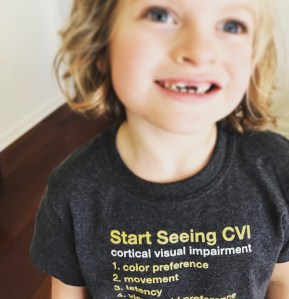
My son is visually impaired. Learning to say those words was hard. These days I am more likely to say, My son has a cortical visual impairment (CVI). CVI is a brain based visual impairment that interferes with the ability to make sense of what you are looking at. Visually impaired is an inadequate description of my son’s vision. In seven years I have learned that most of the time, when we say blind or visually impaired, we are not talking about my son who has CVI, or about children who have CVI. When we say visually impaired, we are talking about someone with an ocular impairment, which has to do with the structure of the eye. Most everything that goes along with serving a student with an ocular impairment – accommodations, Braille, early learning, education, the Expanded Core Curriculum (ECC), orientation and mobility (O&M), schools for the blind, teachers of the visually impaired (TVI), university vision teacher preparation programs – has almost nothing to do with a child who has CVI. Continue reading “CVI critical mass and advocacy”
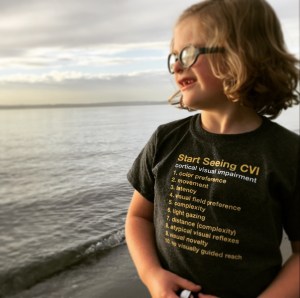
As the parent of a young child who has cortical visual impairment (CVI), I have explained my son’s diagnosis to countless providers. When I say providers, we are talking about early childhood educators and interventionists, neurologists, occupational therapists (OT), ophthalmologists, optometrists, orientation and mobility specialists (O&M), pediatricians, physical therapists, special educators, speech language pathologists, and especially teachers of the visually impaired (TVI). Because of the lack of awareness, education, and knowledge of CVI across the board, it has fallen to this CVI mom to educate everybody who works with my son. When you are a parent of a child with CVI, you spend every single day fighting for your child to receive appropriate services, an appropriate education, and access to the curriculum and the world. Continue reading “This is the year we Start Seeing CVI”

My son was diagnosed with cortical visual impairment (CVI) as a newborn in 2011, before he came home from the children’s hospital neonatal intensive care unit. Like many kids who have CVI, he had a stroke. Or more specifically, hypoxic ischemic encephalopathy, HIE. His birth experience meant absorbing the diagnoses of infant stroke and CVI, as well as the great unknown that goes along with that, because CVI is not a stand alone diagnosis. The doctors, neurologists, called it cortical blindness. This was a day or two after hearing the heart breaking words infant stroke for the first time, a phrase that is not comprehensible in the moment. Cortical blindness, the neurologist said. Because his impairment involves the brain, and not the eye itself, there is nothing you can do. Instead the doctor should have said, Because his visual impairment involves the brain – there is so much you can do. This should be the message to all parents whose child receives a diagnosis of CVI. Continue reading “CVI Parents have three problems”
 Start Seeing CVI