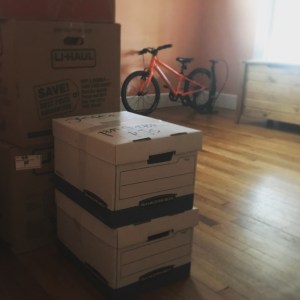
 Moving is hard. Yesterday was about learning what a Great Big Deal the CVI characteristic of novelty still is for my son who has cortical visual impairment (CVI). After driving across the country, itself an exercise in novelty, among many other things, our belongings arrived in a small portion of a vast shipping container. Prior to its arrival, we talked about having our “stuff” again. For several days, we occupied our new home with limited possessions and no furniture. It was the perfect low complexity environment for a child in Phase III CVI to learn about and explore a new living space. Continue reading “Novelty is a Great Big Deal (moving with your child who has CVI)”
Blog

When your child is diagnosed with cortical visual impairment (CVI), you cannot help but ask, What does my child see? As a parent it was hard to even wrap my brain around the words “cortical visual impairment” – or “cortical blindness” – the first time the neurologist said them. Along with the outdated term cortical blindness came other misinformation such as “because it involves the brain and not the eye, there is nothing you can do.” Some people like to say that having CVI is like looking through a slice of Swiss cheese, which does not fly because the eyes work together to create the image in your brain and those gaps get filled in. Others claim that the world appears pixellated to people who have CVI, except that your brain is not a computer. It is far easier to simulate an ocular impairment – such as the grossly distorted world of somebody with myopia. Or the blacked out central vision of a person with progressive macular degeneration. But what does a child with CVI see? Continue reading ““What does my child with CVI see?””
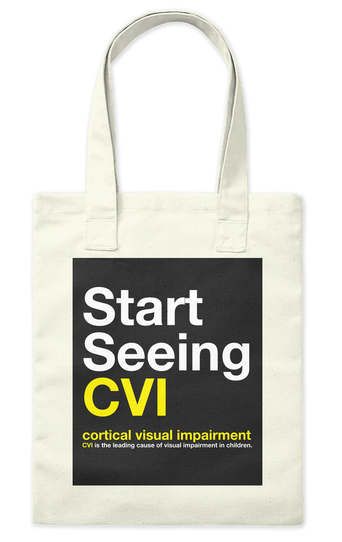 Introducing the Start Seeing CVI tote! Raise awareness of the leading cause of visual impairment in children, cortical visual impairment (CVI), everywhere you go. Totes can be ordered on an ongoing basis, but are only printed on demand, so be sure to allow plenty of time for processing and shipping. Continue reading “Start Seeing CVI tote!”

Below is a conversation around the topic of behaviors, coping mechanisms, and sensory regulation. This was an exchange with our occupational therapist (OT) that helped deepen my understanding of my son, who has cortical visual impairment (CVI). Other parents might find this conversation useful too. Our kids with CVI have inherent sensory processing differences, and as a parent, it can be difficult to discriminate the CVI from the sensory processing. Continue reading “Speaking of CVI, behavior and sensory regulation”
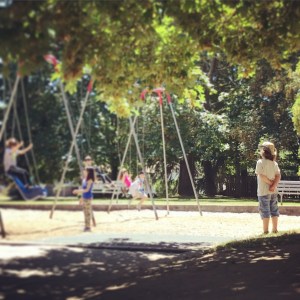
On an unhurried summer day, at last, we stopped at a favorite playground. For my son who has cortical visual impairment (CVI), favorite playground means ample tree shade (photosensitive, though he won’t always admit it). It also means a good selection of slides, such as “curly slide.” Slides have been his preferred playground play for some time. Slides are downhill, his favorite. Slides are fairly easy, once you figure out how to navigate to the top, not always accessible or obvious to a child with CVI. Ladder can look like lots of different things. Lastly, slides are fast. Continue reading “Waiting to play”
 Start Seeing CVI